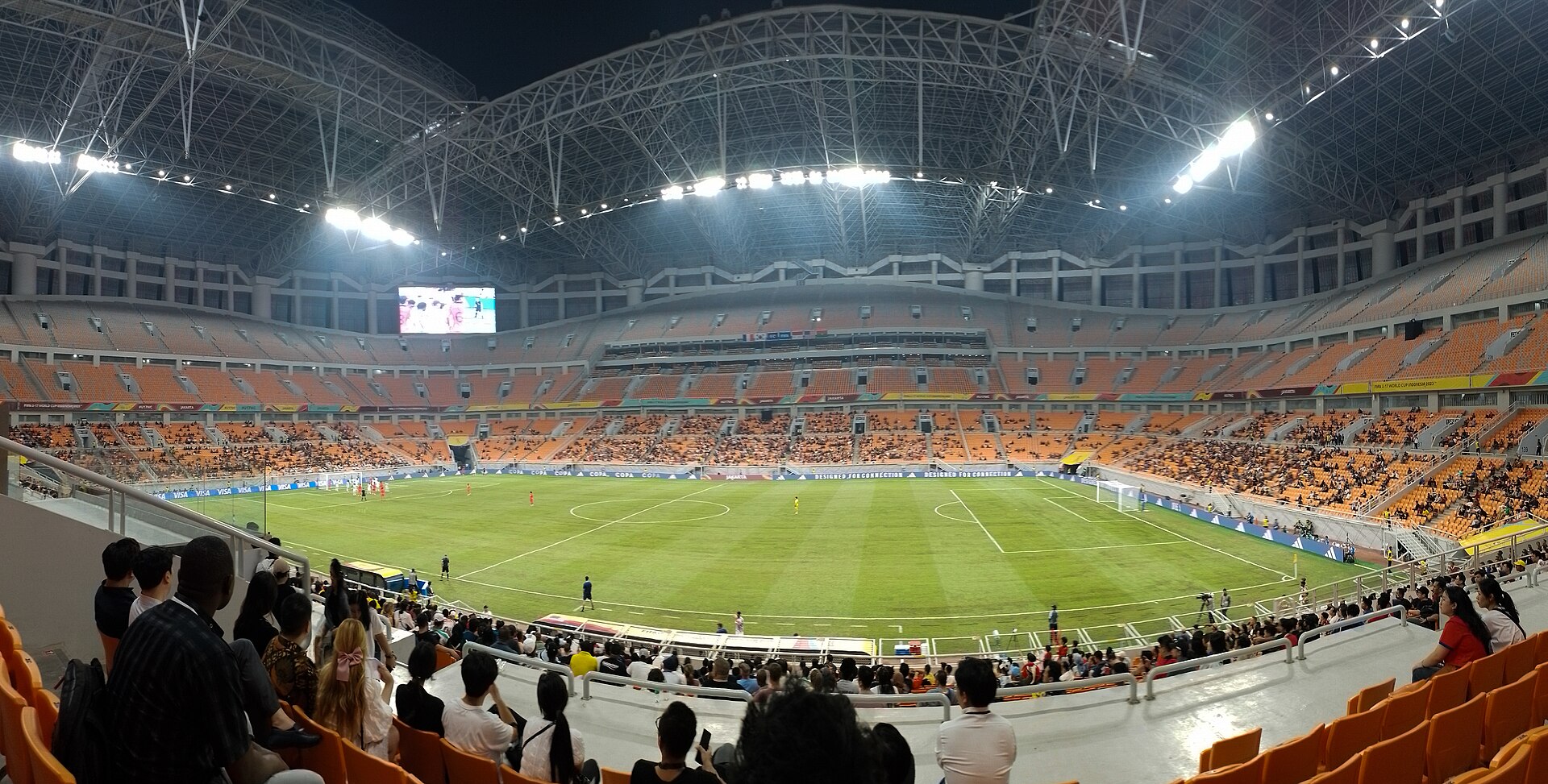
Inside Jakarta International Stadium during the 2023 FIFA U-17 World Cup. Photo: RasyaAbhirama13, CC BY-SA 4.0, via Wikimedia Commons.

Indonesia has some of the biggest and loudest football grounds in Asia. Some are brand-new arenas with retractable roofs; others are concrete bowls with running tracks that have hosted league football for decades. This guide covers the grounds you are most likely to visit in the 2026-27 BRI Super League, plus the national stadium in Jakarta. Capacities are the official figures used for the current season.
Jakarta International Stadium (JIS)
Jakarta International Stadium in Papanggo, Tanjung Priok, North Jakarta, is the largest stadium in the country, with 82,000 seats. It had its grand opening in July 2022 and has a retractable roof, the first at an Indonesian football ground. JIS hosted more matches than any other venue at the 2023 FIFA U-17 World Cup.
It is the home of Persija Jakarta, although Persija sometimes move games when JIS is booked for concerts. Getting there is easy by Jakarta standards: the KRL Commuter Line has a station named after the stadium right next to it, and Transjakarta buses run from Senen, Monas and Tanjung Priok.
Gelora Bung Karno (GBK), Senayan
The Gelora Bung Karno Main Stadium in Senayan, Central Jakarta, opened in 1962 for the Asian Games and was partly funded by a Soviet loan. After a 2016-18 renovation it holds 77,193 people on individual seats. It hosted the 2007 AFC Asian Cup final and the 2018 Asian Games ceremonies, and it is the usual home of the national team (see our Timnas Indonesia guide).
Persija have registered GBK as an alternative venue for 2026-27, and their home game against Persib Bandung on 12 September 2026 was played there. The nearest MRT station is Istora Mandiri, and Palmerah KRL station is close by.
Gelora Bung Tomo (GBT), Surabaya
Home of Persebaya Surabaya since 2012, Gelora Bung Tomo opened in 2010 and now holds 46,806. It was the main venue for Indonesia's own group games at the 2023 U-17 World Cup. The atmosphere created by Persebaya's supporters, the Bonek, is famous across the country.
GBT is in Benowo on Surabaya's far western edge, so allow 40-60 minutes by road from the centre, more on match nights. The Wirawiri Suroboyo feeder bus stops at "Stadion GBT".
Gelora Bandung Lautan Api (GBLA), Bandung
GBLA in Gedebage, eastern Bandung, opened in 2013 and holds 38,000 on individual seats. The name refers to "Bandung Lautan Api" (Bandung Sea of Fire), an episode from the independence struggle. It is home to Persib Bandung, whose blue-clad Bobotoh fill the stands.
The ground is unusually easy to reach from Jakarta: the Whoosh high-speed train from Halim stops at Tegalluar station right beside the stadium.
Kanjuruhan Stadium, Malang
Kanjuruhan in Kepanjen, south of Malang, is the home of Arema FC. On 1 October 2022 at least 135 people died in a crush at the stadium after police fired tear gas following a match, the deadliest disaster in Indonesian football. The government ordered the ground to be demolished and rebuilt to FIFA standards.
The rebuilt stadium was completed at the end of 2024 at a cost of around Rp 350 billion and officially reopened by President Prabowo Subianto on 17 March 2025. Capacity is now 21,603, roughly half the old figure. Kanjuruhan is about 20 km south of Malang city, so allow 40-60 minutes by car.
Kapten I Wayan Dipta Stadium, Gianyar (Bali)
If you are on holiday in Bali, this is your ground. Home of Bali United since 2015, the stadium in Buruan, Blahbatuh, opened in 2003 and now holds 18,000. Its record crowd of 25,057 came in 2019, before seats were reduced.
It sits about 25 km north-east of Denpasar and 20-30 minutes south of Ubud. From Seminyak, Canggu or the airport allow 1-1.5 hours by car or ride-hailing app, longer on match days. Other clubs occasionally borrow the stadium; in 2026-27 both Persija and Isenmulang Kalteng FC have played "home" games here.
Pakansari Stadium, Cibinong
Pakansari, in Cibinong, Bogor Regency, opened in 2015 and holds 30,000. It stood in for GBK during its renovation, hosting Indonesia's home legs of the 2016 AFF Championship semi-final and final, and it staged the men's football gold medal match at the 2018 Asian Games. In 2026-27 it is home to newly promoted Garudayaksa FC. KRL trains run to Cibinong and Bojonggede, then it is a short ride-hail.
Banten International Stadium, Serang
Opened in May 2022, Banten International Stadium near Serang seats 30,000 and has a design drawing on Baduy, batik and bamboo motifs. It is the home of Dewa United Banten, and in autumn 2026 it also hosted Persita Tangerang while storm damage to the Indomilk Arena roof was repaired. It is south of Serang with limited public transport, so plan on 1.5-2 hours by car from Jakarta.
Yogyakarta and Central Java
- Maguwoharjo Stadium, Sleman (20,594): opened in 2007 and nicknamed "Little San Siro", home of PSS Sleman. It is about 10 km north-east of Malioboro.
- Sultan Agung Stadium, Bantul (25,000): home of PSIM Yogyakarta in 2026-27, because their traditional Mandala Krida ground does not meet league requirements.
- Jatidiri Stadium, Semarang (18,000): opened in 1991 and renovated since 2016, now home to Java United FC, the club formerly known as Malut United.
Further afield
Not every club plays in its home city. PSM Makassar use the Gelora B.J. Habibie Stadium in Parepare, about 150 km north of Makassar, because Makassar has no suitable stadium at present. Smaller grounds such as Persijap's Gelora Bumi Kartini in Jepara (8,570) and Madura United's Gelora Madura Ratu Pamelingan in Pamekasan (7,000) give a more intimate, local feel.
Tips for visiting any Indonesian stadium
- Check the venue every week. Clubs change grounds at short notice because of concerts, repairs, permits or, in Kalimantan, forest-fire haze. Confirm on the club's social media or ileague.id.
- Buy tickets online in advance. Most clubs sell e-tickets through their own app or website, often with ID verification.
- Arrive early. Traffic around big grounds can be severe, and security checks take time.
- Use ride-hailing or rail. Parking is limited, and Grab or Gojek drop-off points are usually signposted.
For the full matchday routine, read our guide to watching football in Indonesia, or browse all the clubs to find your nearest ground.
Sources
- https://en.wikipedia.org/wiki/2026%E2%80%9327_Super_League_(Indonesia)
- https://en.wikipedia.org/wiki/Jakarta_International_Stadium
- https://en.wikipedia.org/wiki/Gelora_Bung_Karno_Main_Stadium
- https://en.wikipedia.org/wiki/Gelora_Bung_Tomo_Stadium
- https://en.wikipedia.org/wiki/Gelora_Bandung_Lautan_Api_Stadium
- https://en.wikipedia.org/wiki/Kanjuruhan_Stadium
- https://en.wikipedia.org/wiki/Kapten_I_Wayan_Dipta_Stadium
- https://en.wikipedia.org/wiki/Pakansari_Stadium
- https://en.wikipedia.org/wiki/Banten_International_Stadium
- https://en.wikipedia.org/wiki/Maguwoharjo_Stadium
- https://en.wikipedia.org/wiki/Jatidiri_Stadium
- https://en.wikipedia.org/wiki/2023_FIFA_U-17_World_Cup
Updated weekly through the 2026-27 season. Spotted something out of date? Use the Submit an Update button at the top of the page.