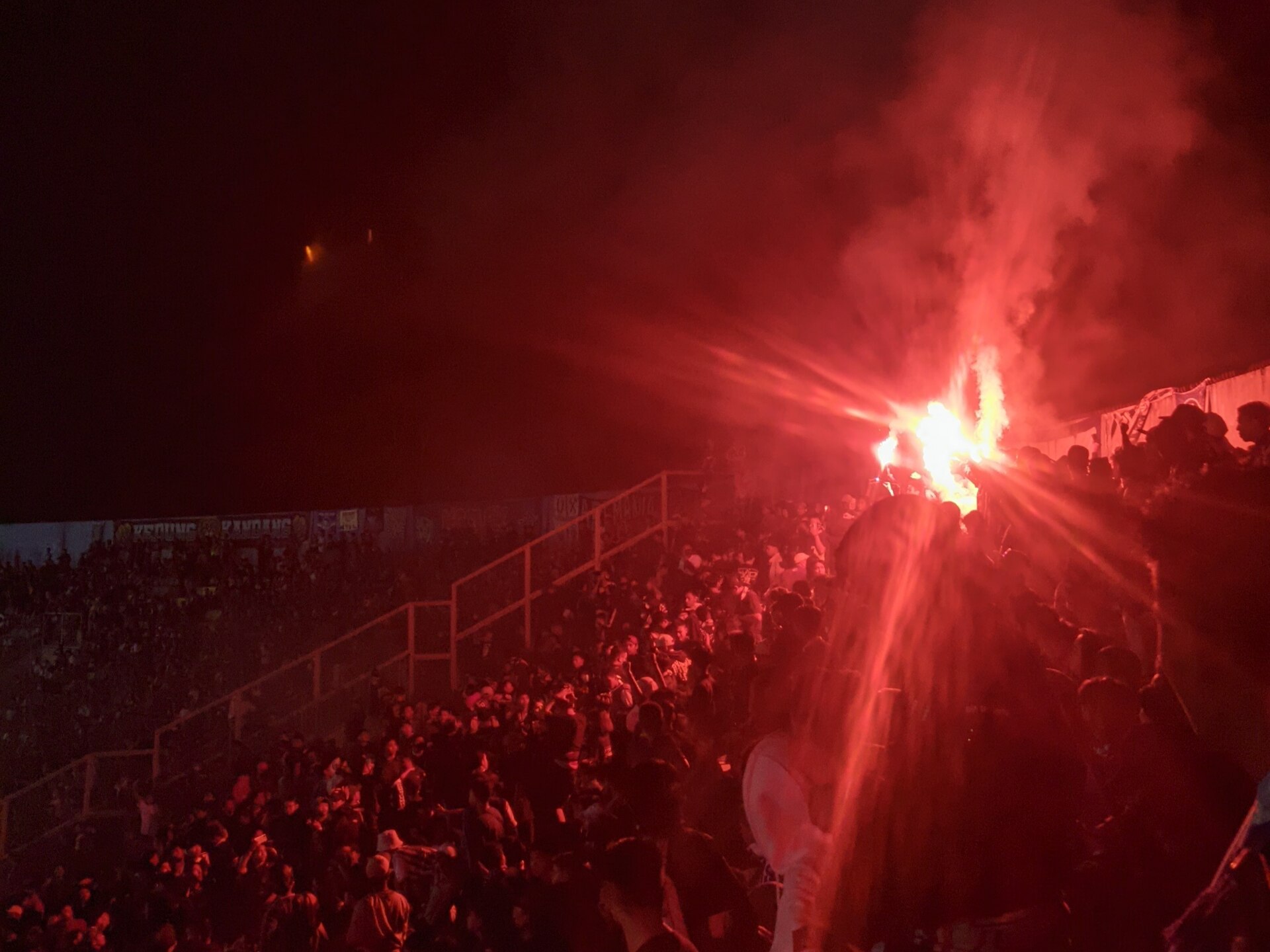
Arema supporters light a flare in the stands during an evening match in May 2022. Photo: BurningHill, CC BY 4.0, via Wikimedia Commons.

If you go to one match in Indonesia, you will remember the noise. Indonesian suporter culture is one of the most intense in Asia: tens of thousands of fans singing for 90 minutes, giant tifo displays, drums, flags and a fierce sense of local identity. It also has a darker side, and the rules have tightened sharply since 2022. Here is what a visitor should know.
Supporter groups, not just fans
Most Indonesian clubs are followed by organised supporter groups with names, logos, merchandise, regional branches and their own sections of the tribun (stand). Some groups are huge membership organisations; others are newer ultras-style crews modelled on Italian curva culture, often occupying the north or south end. Many clubs have several groups, and women's sections are common.
The big names
- The Jakmania (Persija Jakarta): founded in December 1997 to bring the capital's scattered fans together. Famous for orange, the club's colour at the time, even though Persija have since returned to red. The anthem Persija Menyatukan Kita Semua is sung after matches.
- Bobotoh (Persib Bandung): a Sundanese word for people who raise the spirits of those about to fight. Viking Persib Club, founded in 1993, is considered Indonesia's first formal supporters' organisation; Northern Wall and Southside Terrace are other well-known groups. Fans sing Halo-Halo Bandung at the start of matches.
- Bonek (Persebaya Surabaya): short for bondho nekat, roughly "reckless with no resources", a nod to fans who follow the team with little more than determination. Green Nord 27 is one of the best-known organised Bonek groups.
- Aremania (Arema FC): famously leaderless ("no leader, just together"), named the best supporters in Indonesia by PSSI in 2006, and known for songs such as Salam Satu Jiwa ("one soul"). Female fans are Aremanita.
- Slemania and Brigata Curva Sud (PSS Sleman): Slemania (2000) in the north stand and BCS (2011) in the south. BCS is widely admired for its choreography, and Maguwoharjo's south end is known for non-stop singing.
- Brajamusti and The Maident (PSIM Yogyakarta): the club has retired shirt numbers 1 and 12 in their honour.
- The Macz Man (PSM Makassar): the best-known supporter group of one of the oldest clubs in the country.
- Semeton Dewata (Bali United): semeton means brothers and Dewata refers to Bali, the island of the gods. They usually fill the east stand at Kapten I Wayan Dipta, alongside Northsideboys12 and Basudewa Curva Sud.
- Pusamania (Borneo FC Samarinda): the club was formed in 2014 by former supporters of Putra Samarinda and was originally called Pusamania Borneo FC.
Every club page lists its supporter groups, so browse the clubs to find yours.
Tifo, chants and choreography
Big matches often start with a koreografi (choreography): a stand-sized banner or a mosaic of coloured cards. Aremania produced a banner of around 15,000 square metres for a match against Persib in 2014, said to be one of the largest ever made. Singing is often backed by drums and led from the front of the stand, and many groups have recorded their own songs. Flares appear too, but they are banned and clubs are fined when they are lit.
Friendships and feuds
Alliances and hatreds between groups shape the whole scene. Bonek and The Jakmania have a long-standing friendship; The Jakmania and Bobotoh, and Bonek and Aremania, are bitter enemies. Supporters sometimes come together across divides: in the days after the 2022 Kanjuruhan disaster, fans of PSIM, PSS and Persis held a joint peaceful gathering at Maguwoharjo. Our guide to the great rivalries explains the main feuds.
Violence, Kanjuruhan and the safety reforms
Indonesian football has a long history of supporter violence, with at least 95 football-related deaths recorded between 2005 and 2018. The worst tragedy came on 1 October 2022 at Kanjuruhan Stadium in Malang Regency, when police fired tear gas into the stands after a match and 135 people died in the crush that followed. The disaster led to a national review of stadium safety and policing, the rebuilding of Kanjuruhan and a ban on away supporters at league matches.
That ban has now been eased. I-League allowed visiting fans back for 2026-27, with each match assessed individually and responsibility placed on clubs and their supporters. The highest-risk games can still go ahead without away fans: Persija's home match against Persib in September 2026 was played without Bobotoh. Sanctions are real. After crowd trouble and flares at Persita v Persija in October 2026, The Jakmania were banned from six away matches and Persija were fined. Before the season opened, representatives of supporters from all 18 clubs made a joint declaration at Kapten I Wayan Dipta, pledging to keep matches safe and to reject violence and racism.
How to enjoy it as a visitor
- Pick the right seats. The ultras ends are exciting but crowded and standing-only in spirit. A covered main stand or VIP seat is a calmer first experience.
- Wear neutral or home colours. Never wear a rival club's shirt or colours, especially Persebaya green at Arema, or Persija red or Jakmania orange at Persib.
- Buy tickets through official channels. Some clubs require Indonesian ID (NIK) to buy online, so ask your hotel or a local friend to help, and check our matchday guide.
- Avoid the highest-risk derbies as a neutral, and be cautious around stadiums and transport hubs before and after them.
- Follow steward and police instructions, know where the exits are, and leave calmly at full time.
- Join in respectfully. Clapping along and learning a chorus goes down well. Our glossary will help with the words.
- Be respectful at Kanjuruhan, where the 2022 victims are remembered.
Sources
- https://en.wikipedia.org/wiki/Persija_Jakarta
- https://en.wikipedia.org/wiki/Persib_Bandung
- https://en.wikipedia.org/wiki/Persebaya_Surabaya
- https://en.wikipedia.org/wiki/Aremania
- https://en.wikipedia.org/wiki/PSS_Sleman
- https://en.wikipedia.org/wiki/PSIM_Yogyakarta
- https://en.wikipedia.org/wiki/Bali_United_F.C.
- https://en.wikipedia.org/wiki/Borneo_F.C._Samarinda
- https://en.wikipedia.org/wiki/Indonesian_El_Cl%C3%A1sico
- https://en.wikipedia.org/wiki/Kanjuruhan_Stadium_disaster
- https://en.wikipedia.org/wiki/Football_in_Indonesia
- https://skor.id/bola-nasional/sk-01361097/the-macz-man-suporter-pembawa-pesan-damai-dari-timur
- https://repository.uisi.ac.id/924/
- https://commons.wikimedia.org/wiki/File:Gabungan_Suporter_Trah_Mataram_(3).jpg
- https://www.gebrak.id/?p=51472
- https://www.gebrak.id/?p=59829
- https://www.rctiplus.com/news/detail/olahraga/5470128/persija-vs-persib-resmi-digelar-di-sugbk--tapi-ada-satu-hal-yang-bikin-bobotoh-tak-boleh-hadir
- https://bali.antaranews.com/berita/412848/18-perwakilan-suporter-super-league-deklarasi-jaga-keamanan-dan-sportivitas

Updated weekly through the 2026-27 season. Spotted something out of date? Use the Submit an Update button at the top of the page.