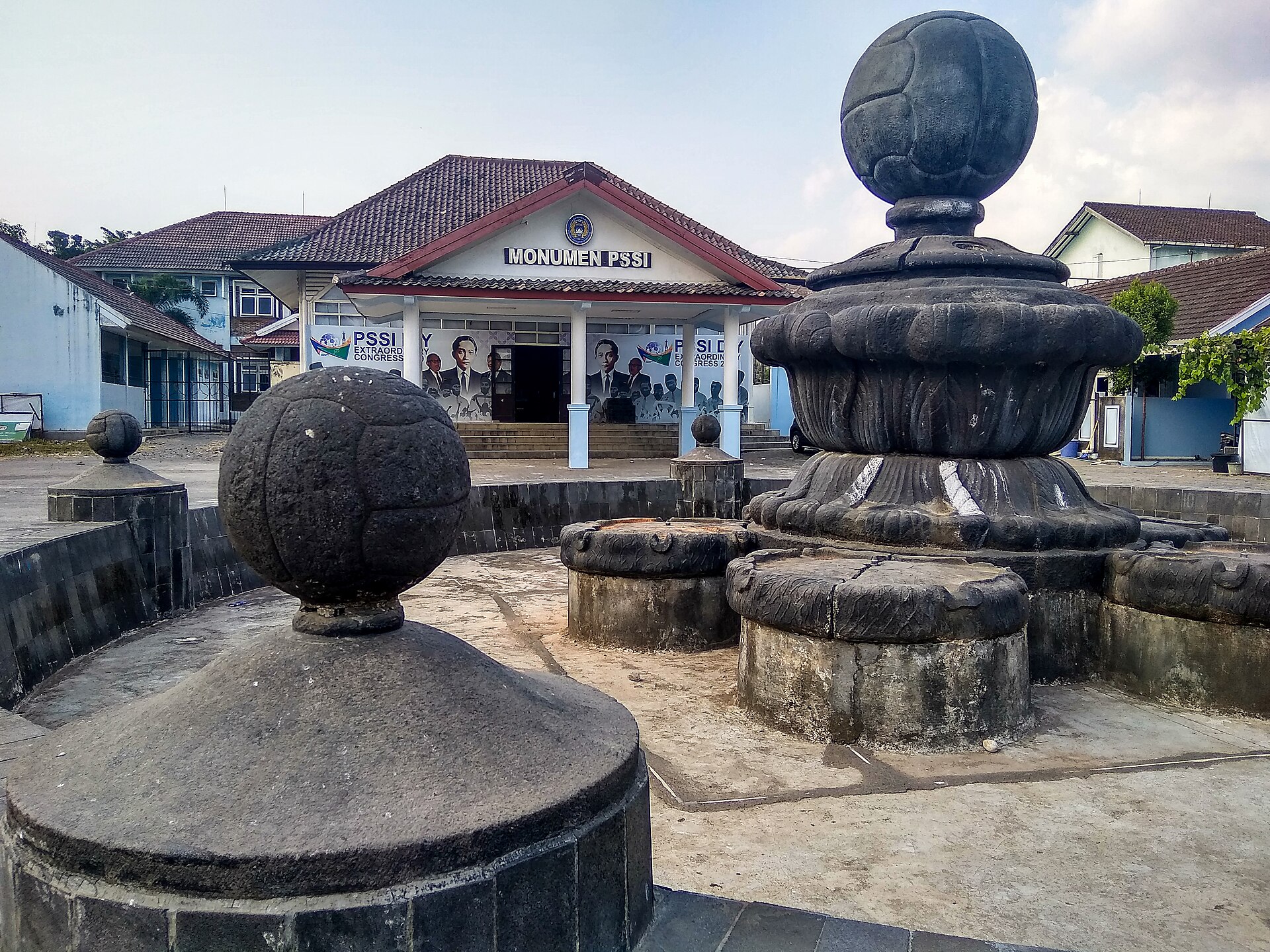
The PSSI Monument in Yogyakarta, marking the city where Indonesia's football association was founded in 1930. Photo: Fandy Aprianto Rohman, CC BY-SA 4.0, via Wikimedia Commons.

Football has been Indonesia's favourite sport for about a century. Its story runs through Dutch colonial rule, the independence struggle, rival leagues, a FIFA suspension and one of the worst stadium disasters in the game's history. Here is the short version for newcomers.
Colonial beginnings
Football was already being played in the Dutch East Indies in the early 20th century: UNI Bandung, now an amateur club under the Persib umbrella, dates from 1903. By 1914 the colonial football body (NIVB) was running an inter-city championship, at first dominated by European teams and later opened up to Chinese and pribumi (indigenous) players. Some of today's clubs date from that era: PSM Makassar was founded in 1915 as the Makassaarsche Voetbalbond, making it one of the oldest clubs still competing at the top level.
1930: football as a national cause
On 19 April 1930, in Yogyakarta, seven local football unions founded PSSI, the association that still governs the game today. Its first chairman was Soeratin Sosrosoegondo, an engineer active in the independence movement. The founders were the unions that became:
- Persija Jakarta (then VIJ)
- Persib Bandung (then BIVB)
- PSIM Yogyakarta
- Persebaya Surabaya (then SIVB)
- Persis Solo, PPSM Magelang and PSM Madiun
The founding is commemorated by the Monumen PSSI in Yogyakarta, next to the Mandala Krida stadium. The new association soon organised its own national championship, the Perserikatan, from 1931. PSIM won it in 1932, and Persija (as VIJ) and Persis Solo dominated the 1930s.
The 1938 World Cup
The Dutch East Indies became the first Asian team to play at a World Cup, in France in 1938. The squad was selected by the colonial federation (NIVU), not PSSI, and Soeratin protested at the arrangement. The team was captained by Achmad Nawir and lost 6-0 to Hungary in Reims on 5 June 1938. In the knockout format of the time, that single game was the whole campaign. Indonesia has not qualified for a World Cup since. Our guide to the national team picks up the story after independence.
Perserikatan and Galatama
After independence the Perserikatan continued as an amateur competition between city and regency teams (the Persi- names you still see everywhere). It produced huge local loyalties: the 1985 final between Persib and PSMS Medan was reported to have drawn around 150,000 people to Gelora Bung Karno in Jakarta.
In 1979 PSSI launched Galatama, a semi-professional league of company-backed clubs. It was among the earliest such leagues in Asia, and in its early years it allowed foreign players, including Singapore's Fandi Ahmad at NIAC Mitra. Galatama later banned imports and suffered from match-fixing and bribery scandals, and its popularity faded. Arema, founded in 1987, won the Galatama title in 1992-93.
1994: one national league
In 1994 PSSI merged the two competitions into Liga Indonesia, hoping to combine the passion of the Perserikatan with the professionalism of Galatama. Persib won the first title in 1994-95. The 1997-98 season was abandoned amid Indonesia's political and economic crisis.
2008-2016: a professional league, a split and a ban
The fully professional Indonesia Super League (ISL) began in 2008-09 with 18 clubs. Then politics intervened. In 2011 a new PSSI leadership installed a different league operator and launched a rival Indonesian Premier League, while many clubs stayed in the ISL, which the official association refused to recognise. This period of dualisme (dualism) left Indonesia with two top divisions, and even two versions of some clubs, until a PSSI congress reunited the game in March 2013.
Peace did not last. In April 2015 the sports ministry froze PSSI's activities in a dispute over club verification, the league was halted, and in May 2015 FIFA suspended Indonesia for government interference. Stand-in tournaments filled the gap, including the first Piala Presiden. FIFA lifted the suspension on 13 May 2016.
The Liga 1 era
The top flight was relaunched as Liga 1 in 2017 under a new operator, PT Liga Indonesia Baru. The first champions, Bhayangkara, a club run by the national police, won on head-to-head. Bali United, a club founded only in 2015, won their first title in 2019. The 2020 season was cancelled because of COVID-19, and the 2021-22 campaign was played in bio-secure bubbles.
2022: the Kanjuruhan disaster
On 1 October 2022, after Arema lost 3-2 at home to Persebaya at Kanjuruhan Stadium in Malang Regency, supporters went on to the pitch and police fired tear gas into the stands. In the crush at the exits that followed, 135 people died and hundreds more were injured. It is the second-deadliest stadium disaster in football history.
The league was suspended, and when it resumed in December 2022 the remaining first-round matches were played behind closed doors. That season ended without relegation. Six people were prosecuted; police officers were among those eventually jailed. With FIFA's involvement, the government and PSSI set up a programme to transform stadium safety and security. Kanjuruhan was demolished and rebuilt, with the work completed in January 2025, and away supporters were barred from league matches for several seasons. The disaster remains raw in Malang and across Indonesian football. At the rebuilt stadium, the ruined Gate 13 has been kept and permanently sealed as a memorial to the victims.
2025 onwards: the Super League
In 2025 the top flight took back the Super League name, Liga 2 became the Championship, and the operator was renamed I-League. Persib's 2025-26 title completed a hat-trick of championships. In 2026-27 away fans have been allowed back on a match-by-match basis, and the league features clubs from Sumatra, Java, Bali, Kalimantan and Sulawesi. Our Super League explainer covers how it works today, and you can browse every current club.
Sources
- https://en.wikipedia.org/wiki/Football_Association_of_Indonesia
- https://en.wikipedia.org/wiki/Football_in_Indonesia
- https://en.wikipedia.org/wiki/Perserikatan
- https://en.wikipedia.org/wiki/Galatama
- https://en.wikipedia.org/wiki/Liga_Indonesia_Premier_Division
- https://en.wikipedia.org/wiki/Super_League_(Indonesia)
- https://en.wikipedia.org/wiki/Indonesia_national_football_team
- https://en.wikipedia.org/wiki/Kanjuruhan_Stadium_disaster
- https://en.wikipedia.org/wiki/PSM_Makassar
- https://en.wikipedia.org/wiki/PSIM_Yogyakarta
- https://en.wikipedia.org/wiki/Indonesian_El_Cl%C3%A1sico
- https://en.wikipedia.org/wiki/Piala_Presiden_(Indonesia)
- https://www.gebrak.id/?p=51472
Updated weekly through the 2026-27 season. Spotted something out of date? Use the Submit an Update button at the top of the page.